


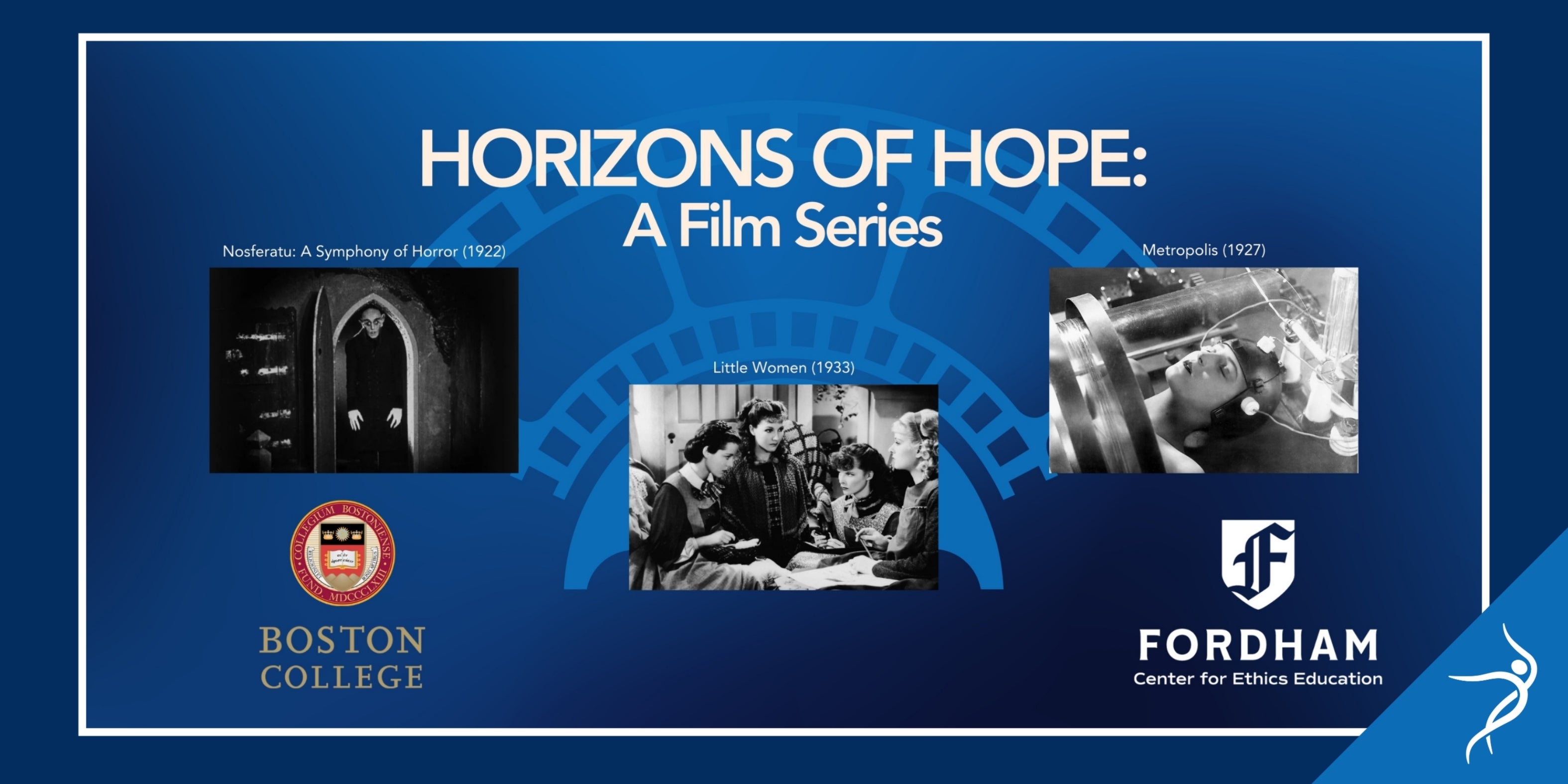
Horizons of Hope
A three film series, curated to inspire
Event Details
Related Links
Mar 9 - Nosferatu: A Symphony of Horror (1922)
Join us for this silent horror classic loosely based on Bram Stoker's novel, "Dracula." The vampire count (Max Schreck) leaves his sinister castle in the Carpathian mountains to sail on a doomed ship bringing him to 1838 Bremen where his dark deeds are undone by a brave young woman and the first light of dawn. Directed by F.W. Murnau, the German production is most notable for its eerie portrayal of the vampire in images which seem to personify evil and dread in a movie even more remarkable for having been filmed mostly on location rather than in the controlled confines of a studio.*
*Language adapted from USCCB (United States Conference of Catholic Bishops.
About Thomas Massaro, S.J., panelist
Thomas Massaro, S.J., is the Laurence J. McGinley Professor of Religion and Society at Fordham University. A Jesuit priest of the USA East Province, he joined Fordham in 2018 as professor of moral theology and teaches undergraduate and graduate courses on many aspects of Catholic social teaching, peacemaking, the sociology of religion, and the constructive role of religion in public life.
Currently he is associate director of the Center for Ethics Education and continues to teach select classes such as Theologies of Peace and Professional Ethics for Pastoral Ministry. In fall 2024 he was named to the McGinley Chair of Religion and Society.
Prior to Fordham, Father Massaro was professor of moral theology at Weston Jesuit School of Theology in Cambridge, Massachusetts; at its successor, the Boston College School of Theology and Ministry; and at the Jesuit School of Theology of Santa Clara University, where he also served as dean for four years. He earned his doctorate in Christian social ethics from Emory University in 1997, holds three master's degrees in philosophy and theology, and received his bachelor's degree from Amherst College.
A prolific writer and former columnist for America magazine, Father Massaro’s 11 books and over 150 published articles address topics in Christian social ethics that draw upon wide-ranging studies in political science, economics, philosophy, and theology. His most recent books are Pope Francis as Moral Leader (Paulist Press, 2023) and Living Justice: Catholic Social Teaching in Action (Rowman & Littlefield, 2023).
Father Massaro remains committed to hands-on social activism. He served a six-year term on the Peace Commission of the City of Cambridge and is a co-founder and national steering committee member of Catholic Scholars for Worker Justice.
A sought-after speaker, Father Massaro enjoys engaging audiences on topics of social justice and the exercise of faith-based civic responsibility. He is eager to uphold the tradition of delivering public McGinley Chair lectures and plans to use the semiannual talks to discuss his research on Catholic social teaching and its contributions to responsible public policies.
Find Out More
Buy Tickets
Mar 23 - Little Women (1933)
Join us for this lovingly sentimental but firmly crafted adaptation of Louisa May Alcott's story of four New England sisters during the Civil War, followed by a thrilling talkback with Boston College's Dr. Matthew Clemente. Director George Cukor depicts the joys and woes of the loving March family household with warmth and sincerity, but most memorable is the ensemble performance of a remarkable cast headed by Katharine Hepburn as serious-minded Jo, Joan Bennett as vain Amy, Frances Dee as prosaic Meg, Jean Parker as waifish Beth and Spring Byington as the girls' beloved Marmee. *
*Language adapted from USCCB (United States Conference of Catholic Bishops).
About Katie Goodman, Panelist
Katie Goodman is a practicing psychotherapist in private practice and a Clinical Supervisor for the Sports Counseling program at Boston College. As a Catholic who returned to her faith as an adult and the mother of young children, she is interested in the ever evolving cultural imagination on the vocations of marriage and family life and is particularly drawn to the intersection of faith and motherhood.
Find Out More
Buy Tickets
Apr 13 - Metropolis (1927)
Meet us at the Sheen Center for this German Expressionist Sci-Fi classic, followed by a thoughtful talkback with Dr. Matthew Clemente of Boston College. This film school favorite depicts a future society ruled by an aristocracy living in luxury above ground while the workers suffer miserably underground, comforted only by the religious faith of a young woman (Brigitte Helm) in whose likeness a sinister scientist (Rudolf Klein-Rogge) fashions a robot inciting the workers to rebel but all ends in reconciliation. Directed by Fritz Lang, the story's melodramatic turns and woolly finale may be dated but not its vivid pictorial sense, grandly expressionistic decor and theme of social justice. *
*Language adapted from USCCB (United States Conference of Catholic Bishops).
About David Gibson, Panelist
David Gibson was appointed the director of the CRC in July 2017, coming to New York’s Jesuit university after a long career as an award-winning religion journalist, author, and filmmaker. He is also a convert to Catholicism and he came by all those vocations by accident--or Providence--while working at the English Program at Vatican Radio in Rome in the late 1980s. He returned to the United States in 1990 and worked for newspapers throughout the New York area and has written for a variety of magazines and periodicals.
Gibson is the author of two books on Catholicism: The Coming Catholic Church: How the Faithful are Shaping a New American Catholicism and The Rule of Benedict: Pope Benedict XVI and His Battle with the Modern World. He co-wrote and co-produced several documentaries on Christianity for CNN and the History Channel and co-authored a book on biblical archeology, Finding Jesus: Faith. Fact. Forgery, the basis of a popular CNN series of the same name.
Before coming to Fordham, Gibson worked for six years as a national reporter at Religion News Service and specialized in coverage of the Vatican and the Catholic Church. Gibson is a frequent media commentator and op-ed writer on topics related to the Catholic Church and religion in America.
About Dr. Shonni Enelow, Panelist
Dr. Shonni Enelow is a Professor and Chair of the English Department at Fordham University.
Dr. Enelow is a critic and scholar who writes about theater and film. She is the author of Joanna Hogg (Contemporary Film Directors series, University of Illinois Press, 2024) and Method Acting and Its Discontents (Northwestern University Press, 2015), which won the George Jean Nathan Award for Dramatic Criticism. Her book with David Levine, A Discourse on Method, was published by 53rd State Press in 2020, and her book with Una Chaudhuri, Research Theatre, Climate Change, and the Ecocide Project, was published by Palgrave in 2014. Her theater scholarship has appeared in Modern Drama, Theater Survey, Theatre Topics, and Theater; her article “Sweating Tennessee Williams” won the Modern Drama Prize in 2019. She writes about film for Reverse Shot, Film Comment, and Criterion, among other venues.